A Channel Does Not Pay You. The Business Behind It Does.
A YouTube channel does not pay you. A business behind the channel does. That single line is why this tool list is split in two: tools that make the videos, and tools that turn views into money.
Most creators own the first half completely – cameras, avatars, clipping, captions, editing – and have nothing at all in the second. A viewer finishes a video, wants more, and finds nowhere to go.
Five steps, and the two that are missing
| 1. Video → | 2. Attention → | 3. Somewhere to go → | 4. Something to buy → | 5. Follow-up |
|---|---|---|---|---|
| You already do this The making half of the list |
People watch and some care Comments, subscribers, repeat viewers |
One page that explains one thing A page, not a website |
One offer, priced and deliverable A product, a service, a membership |
A reply, a receipt, a next step Email, support, delivery |
| Most creators: Owned |
Most creators: Owned |
Most creators: Usually missing |
Most creators: Usually missing |
Most creators: Usually improvised |
The card’s warning is worth repeating: ad revenue alone is the slowest path. It depends on volume you do not control and rates you cannot set, and it pays the same whether a viewer would have happily bought something from you or not. The channel is the audience. The offer is the income.
The ten categories, and when each one is actually your problem
| Category | Tools named | Half | When a creator needs it |
|---|---|---|---|
| Video | HeyGen, Kling AI, Runway, LTX Studio, Captions | Making | Yes – you likely have one already |
| Content | OpusClip, Submagic, Descript, Riverside, CapCut | Making | Yes – cutting and captioning |
| Design | Figma, Recraft, Ideogram and others | Making | Yes – thumbnails and graphics |
| Agents | Claude, ChatGPT, Manus | Making | Yes – scripting, research, admin |
| Websites | Lovable, Framer, Base44, Durable | Money | When you have one offer to explain |
| Apps | Bubble, Replit, Softr, FlutterFlow, Firebase Studio | Money | Rarely – only if the product is software |
| Ads | AdCreative, Creatify, Canva and others | Money | Only once an offer already converts organically |
| Automation | n8n, Make, Zapier | Money | After a chore repeats weekly |
| Leads | Clay, Apollo, Instantly, Hunter | Money | Only for outbound business, with rules attached |
| Sales & support | HubSpot, Lavender, Tidio, Intercom | Money | When you cannot hold customers in your head |
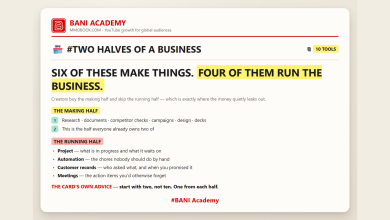
Read the last column and the fifty shrinks to about six tools for most people. The card says the same thing in its own footer: pick one tool per job, not fifty. What changes with growth is not the number of tools but which row becomes urgent – a pattern we mapped for the whole stack in six make things, four run the business.
The post this came from
Watch the reel
Ten jobs, five tools each – the stack that can make you money on YouTube. Posted on the BANI Academy page.
Build the money half in this order
The sequence matters more than the tools. Done in the wrong order, you end up with a landing page nobody visits and an automation sending emails to strangers.
| Step | What you need | What it looks like | Tools | The common mistake |
|---|---|---|---|---|
| 1 | An audience that returns | Comments, repeat viewers, people who ask questions | None | Building a funnel before anyone is walking past |
| 2 | One offer, written in a sentence | “I help X do Y, for Z” | None | Having three offers and explaining none of them |
| 3 | One page that explains it | A single page with the offer, the price and how to buy | A site builder | Building a whole website |
| 4 | One follow-up path | A way to answer, deliver and remember who asked | A sheet or a light CRM | Automating replies to people you have never spoken to |
| 5 | Repeat what worked | More of the videos that brought buyers, not more tools | Automation, later | Adding ads before the offer converts organically |
Step two is the one worth sitting with. If you cannot say what you sell in one sentence, no page builder will rescue it – and the sentence usually comes from the comments under your own videos, where people tell you what they are stuck on. That is the demand-first approach in demand first, applied to an offer instead of a topic.
Step four is where most income quietly leaks. Someone asks about a service, you reply from your phone, and two weeks later nobody remembers what was agreed. A sheet with six columns prevents that, and it is the running half we described in six make things, four run the business.
What counts as an offer when you have a small channel
The word “offer” makes people imagine a course with modules and a sales page. It does not have to be anything like that, and at a few thousand subscribers it probably should not be.
A service you already do. Editing, thumbnails, setup, translation, coaching – whatever people in your comments ask you how to do. It needs no product build and it pays from the first customer.
A small paid resource. The template, checklist or file you made for yourself and keep sending to people privately. If you have sent it three times, it is a product.
A paid version of the free thing. A longer walkthrough, the project files, the spreadsheet behind the video. The audience for it already exists: it is the people who watched to the end.
All three can be tested this month without a website, a funnel or an automation. A pinned comment and a way to pay is enough to find out whether anyone wants it – and that answer is worth more than any of the fifty tools.
The row that comes with obligations
Four of the fifty tools are for finding and contacting people who have never heard of you. They are legitimate business software and they carry rules that a tool list never mentions.
Unsolicited commercial email is regulated in most countries: an honest sender and subject line, a real way to unsubscribe, and in many places prior consent. “Everyone does it” is not a defence, and neither is “the tool did it”.
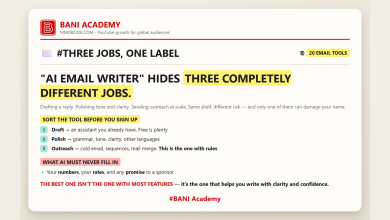
There is also a practical reason for care. Your channel address is where sponsors reply to you. Sending hundreds of near-identical messages from it is the fastest way to have your genuine mail land in spam. If you do outreach, do it from a separate address, in small batches, with a real reason to contact each person – the same argument as in one label, three very different jobs.
And the sanest first version of “leads” for a creator is not outreach at all: it is the people already commenting on your videos, which costs nothing and starts warm.
Frequently asked questions
Is ad revenue really the slowest path?
For most small channels, yes – it depends on volume and rates you do not control. It is real income, just the least responsive to your effort.
When should I build a landing page?
When you can say what you sell in one sentence. Before that, the page has nothing to say.
Do I need a CRM?
Not until you lose track of who asked what. A spreadsheet covers the first dozen customers comfortably.
Can I use the lead tools to find sponsors?
Carefully. Researching who to contact is fine; mass-mailing strangers from your main address is how a creator address ends up in spam folders.
Write the sentence first
Before buying anything from the money half, write one sentence: I help ___ do ___, and it costs ___. Read your comments for a week if the blanks are hard – your audience has probably already told you.
Then build exactly one page, one follow-up path, and nothing else. Pick one tool per job, not fifty. The channel is the audience; the offer is the income – and the offer is a decision, not a subscription.
Learning a lot does not make anyone good. Doing a lot does.
If you want the structure that turns that into a habit, that is what our free challenge is built for: no barrier to entry, a genuine commitment to action, and a refundable commitment fee you get back when you finish. You are not paying for the knowledge. You are betting on yourself finishing, and we hold the stake.
Which half of the list are you missing? Tell us in the comments on the original reel.
For more on building channels for English-speaking audiences, that is what we work on at mmoyoutube.com.
2 Comments